Short answer: for most buyers the Canon EOS R6 Mark III is the better value of the three. At 979.000 OMR for the body it costs 260.900 OMR less than the EOS R5 Mark II at 1,239.900 OMR, and Canon lists it with the same 8.5-stop stabilisation, the same 12 fps mechanical shutter and a faster 40 fps electronic burst. What the R5 Mark II adds is resolution and 8K: a 45 MP stacked sensor against 32.5 MP, internal 8K RAW video against 7K, and a higher-resolution 5.76-million-dot viewfinder. Pick it when you crop hard or work in 8K. The EOS R6 V, at 1,029.000 OMR, shares the R6 Mark III sensor and 7K RAW video but has no viewfinder at all. Canon built it video-first for handheld creators, with 7.5-stop stabilisation and the lightest body here at 688 g. Choose it only if you film and frame on the screen.
All three are Canon full-frame mirrorless cameras on the RF mount, they take the same LP-E6P battery and the same pair of card slots, so the choice comes down to resolution, video, viewfinder and price. Every figure below is from Canon's own specification pages.
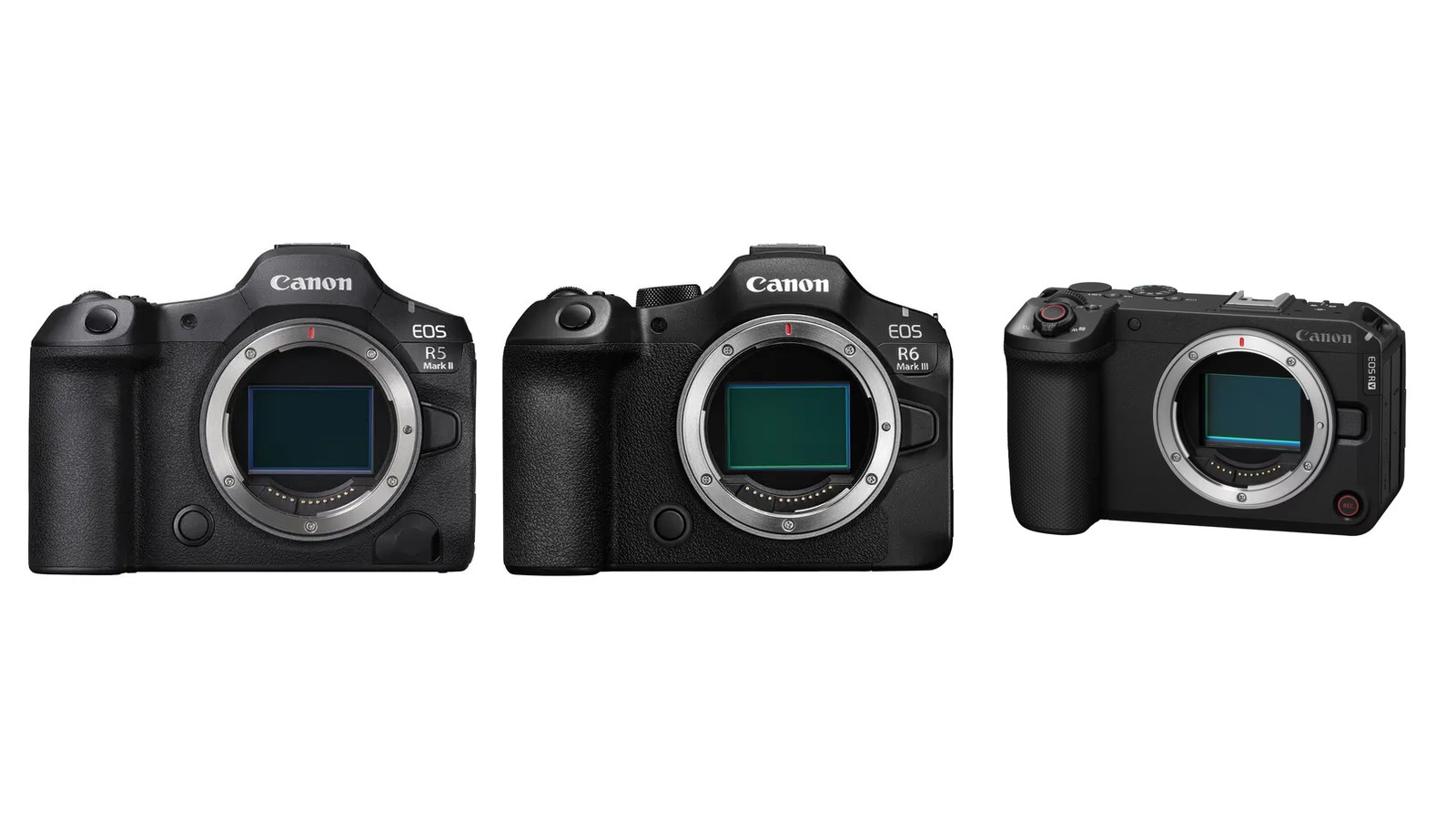
The three side by side
| EOS R5 Mark II | EOS R6 Mark III | EOS R6 V | |
|---|---|---|---|
| Body price (incl. VAT) | 1,239.900 OMR | 979.000 OMR | 1,029.000 OMR |
| Sensor | 45 MP stacked | 32.5 MP | 32.5 MP |
| Top internal RAW video | 8K up to 59.94p | 7K up to 59.94p | 7K up to 59.94p |
| Viewfinder | 5.76M dots | 3.69M dots | None |
| In-body stabilisation | Up to 8.5 stops | Up to 8.5 stops | Up to 7.5 stops |
| Fastest burst | 12 fps mechanical, 30 fps electronic | 12 fps mechanical, 40 fps electronic | 40 fps electronic |
| Battery shots (screen / viewfinder) | 630 / 340 | 620 / 390 | 640 / no viewfinder |
| Weight with card + battery | 746 g | 699 g | 688 g |
Prices checked on 1 November 2026. Stabilisation figures are Canon's centre figures, measured with the RF 24-105mm F2.8 L IS USM Z lens at 105 mm. Canon does not list a mechanical-shutter burst rate for the R6 V.
When the R5 Mark II earns its price
The R5 Mark II is the only one of the three with a 45 MP stacked sensor and internal 8K RAW video. It also has the highest-resolution viewfinder of the three at 5.76 million dots, Wi-Fi 802.11ax and an optional 2.5G Ethernet connection through Canon's battery grip. If you print large, crop wildlife or sport, or work in 8K, those are the reasons to pay more.
R6 Mark III or R6 V: the viewfinder decides
The two R6 bodies share the 32.5 MP sensor, 7K RAW and Open Gate recording. The R6 Mark III is the all-rounder: a viewfinder, a 12 fps mechanical shutter and 8.5-stop stabilisation. The R6 V drops the viewfinder for what Canon calls its smallest full-frame camera with in-body stabilisation, with a vari-angle screen, 4K at 120p with no crop and a vertical tripod socket in the grip for mobile-first content.
Who each camera suits
- Canon EOS R5 Mark II Mirrorless Camera Body 6536C005: professionals who need 45 MP stills and 8K video in one body.
- Canon EOS R6 Mark III Mirrorless Camera Body: weddings, events and hybrid work, with a viewfinder and a mechanical shutter.
- Canon EOS R6 V Mirrorless Camera (Body Only) + FREE Lexar 128GB CFexpress Type B Card: handheld video and content creators who frame on the screen.
“Take your content further with a video-first, full-frame camera made for handheld creation. Compact, cinematic and ready for your stories.” — Canon, EOS R6 V page (read 1 November 2026)
More comparisons
Frequently asked questions
Is the Canon EOS R5 Mark II worth the extra over the R6 Mark III?
Only if you need what the R6 Mark III does not have. Canon lists the R5 Mark II with a 45 MP stacked sensor, internal 8K RAW video and a 5.76-million-dot viewfinder. The R6 Mark III has a 32.5 MP sensor, 7K RAW video and a 3.69-million-dot viewfinder, with the same 8.5-stop stabilisation and 12 fps mechanical shutter.
Does the Canon EOS R6 V have a viewfinder?
No. Canon's spec page lists the R6 V viewfinder as not provided; you frame on its 3-inch vari-angle screen. Canon describes it as a video-first, full-frame camera made for handheld creation.
Which of the three records 8K video?
Only the R5 Mark II. Canon lists internal 8K RAW up to 59.94p on it. The R6 Mark III and R6 V record internal 7K RAW up to 59.94p and Open Gate RAW up to 29.97p, and all three record 4K up to 119.9p.
What is the difference between the R6 Mark III and the R6 V?
They share a 32.5 MP sensor, 7K RAW video and Open Gate recording. The R6 Mark III adds a 3.69-million-dot viewfinder, a 12 fps mechanical shutter and stabilisation of up to 8.5 stops; the R6 V has no viewfinder, stabilisation of up to 7.5 stops and a lighter body: 688 g with card and battery against 699 g. Canon calls it its smallest full-frame camera with in-body stabilisation.
Which is fastest for bursts?
With the electronic shutter, the R6 Mark III and R6 V reach 40 fps and the R5 Mark II 30 fps. With the mechanical shutter, Canon lists 12 fps on both the R5 Mark II and the R6 Mark III.
Do they use the same batteries and memory cards?
Yes. Canon lists the LP-E6P battery on all three, and each has one CFexpress Type B slot and one SD UHS-II slot.
Which one is the lightest?
The R6 V at 688 g with card and battery, then the R6 Mark III at 699 g, then the R5 Mark II at 746 g.
Sources
- Canon EOS R5 Mark II specifications
- Canon EOS R6 Mark III specifications
- Canon EOS R6 V specifications
- Canon EOS R6 V overview
Last updated: 1 November 2026.