Short answer: Both are Canon's full-frame speed cameras, with a back-illuminated stacked sensor of about 24 MP, Eye Control AF, 12 fps on the mechanical shutter, 6K 60p RAW video and the same LP-E19 battery. The EOS R1 is the flagship: up to 40 fps with the electronic shutter against 30, pre-continuous shooting that starts about half a second before you fully press the button, Action Priority AF for sports such as soccer, basketball and volleyball, a 9.44-million-dot viewfinder, two CFexpress slots and 2.5G wired LAN. The EOS R3 is about 100 g lighter, has a rear screen with about twice the dots, and takes one CFexpress card and one SD card. Choose the R1 if you shoot top-level sport and every frame counts. Choose the R3 if you want most of that speed in a lighter body.
On paper the Canon EOS R1 and EOS R3 look close: about 24 MP, stacked sensor, Eye Control AF, 6K RAW. In the hand they are built for different jobs. Here is what Canon's own manuals and spec pages say, side by side.
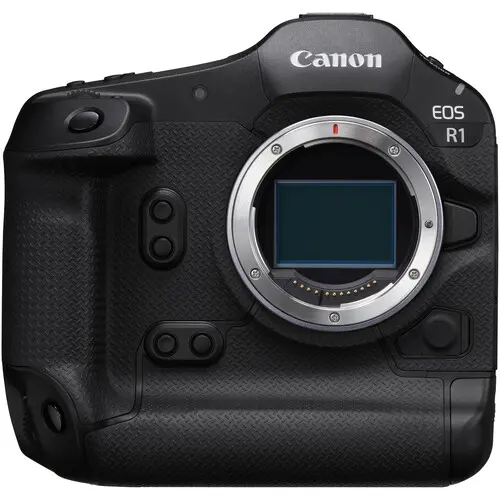
The specs side by side
| Spec | Canon EOS R1 | Canon EOS R3 |
|---|---|---|
| Sensor | 24.2 MP full-frame, back-illuminated stacked CMOS | 24.1 MP full-frame, back-illuminated stacked CMOS |
| Processor | DIGIC Accelerator + DIGIC X | DIGIC X |
| Burst, electronic shutter | up to 40 fps | up to 30 fps |
| Burst, mechanical shutter | up to 12 fps | up to 12 fps |
| Fastest shutter speed | 1/64000 s (electronic) | 1/64000 s (electronic) |
| Pre-continuous shooting | Yes, about 0.5 s before the full press | Not listed by Canon |
| Action Priority AF (sports) | Yes | Not listed by Canon |
| Eye Control AF | Yes, for stills | Yes, for stills |
| Animal detection | Dogs, cats, birds, horses | Dogs, cats, birds |
| Vehicle detection | Sports cars, motorcycles, aircraft, trains | Motorsport vehicles |
| Stabilisation with a compatible lens | up to 8.5 stops (centre) | up to 8 stops |
| Viewfinder | 0.64-inch OLED, about 9.44 million dots, 0.90x | 0.5-inch OLED, about 5.76 million dots, 0.76x |
| Rear screen | 3.2-inch touch, about 2.1 million dots | 3.2-inch touch, about 4.15 million dots |
| RAW video | 6K 60p RAW, 12-bit | 6K 60p RAW, 12-bit |
| High frame rate | 4K 120p | 4K 120p |
| Canon Log | Canon Log 2 and Canon Log 3 | Canon Log 3 |
| Card slots | 2 x CFexpress | 1 x CFexpress Type B + 1 x SD (UHS-II) |
| Battery | LP-E19 | LP-E19 |
| Shots per charge, viewfinder (power saving) | about 700 | about 620 |
| Weight with battery and card | about 1115 g | about 1015 g |
| Wired LAN | 2.5G Base-T | 1000BASE-T |
| Wi-Fi | IEEE 802.11ax | IEEE 802.11ac |
| Operating temperature | 0 to 45°C | 0 to 40°C |
Where the Canon EOS R1 wins
- Faster burst: up to 40 fps with the electronic shutter, against 30.
- Catches the moment before you press: pre-continuous shooting records about half a second before the full press.
- Made for sport: Action Priority AF follows the player with the action in sports such as soccer, basketball and volleyball.
- Higher-resolution viewfinder: about 9.44 million dots, against 5.76 million.
- Two CFexpress slots and 2.5G wired LAN for fast hand-off at the venue.
“Blaze your way through with up to 40 fps continuous shooting on the EOS R1, the flagship of the full-frame mirrorless R-series, which features Dual Pixel Intelligent AF that keeps your subject focused no matter the situation.” — Canon India, EOS R1 specifications page (read 31 October 2026)
Where the Canon EOS R3 wins
- Lighter: about 1015 g with battery and card, against about 1115 g.
- Rear screen with more dots: about 4.15 million, against 2.1 million.
- Takes an SD card: one CFexpress Type B slot and one SD slot, so your SD cards still work.
- Most of the speed: up to 30 fps, Eye Control AF and 6K 60p RAW, in a body about 100 g lighter.
Which one should you buy?
- Buy the Canon EOS R1 if you shoot top-level sport such as soccer, basketball or volleyball, need the fastest burst and pre-continuous shooting, and send pictures from the venue over wired LAN.
- Buy the Canon EOS R3 if you want flagship speed in a lighter body, want more screen dots, or already own SD cards.
Both cameras are sold as a body only. Canon's specs can change with firmware: this page reads the R1 guide for firmware 1.3.0 or later and the R3 guide for firmware 2.1.0 or later.
More comparisons
Frequently asked questions
Which is faster, the Canon EOS R1 or the EOS R3?
The EOS R1. Canon lists up to 40 fps with the electronic shutter on the R1, against up to 30 fps on the R3. With the mechanical shutter both reach up to 12 fps.
Do the EOS R1 and EOS R3 use the same battery?
Yes. Canon lists the LP-E19 battery pack for both cameras.
Can I use SD cards in the EOS R1?
No. The EOS R1 has two CFexpress card slots. The EOS R3 has one CFexpress Type B slot and one SD slot that supports UHS-II.
What is pre-continuous shooting on the EOS R1?
The camera starts shooting in continuous mode before you press the shutter button all the way. Canon says that at about 40 shots per second it records about 0.5 seconds before the full press, using the electronic shutter. Canon does not list this feature for the EOS R3.
Which is better for video?
Both record 6K 60p RAW with 12-bit data and 4K at up to 120p. The R1 adds Canon Log 2 next to Canon Log 3. For the R3, Canon lists 4K 60p oversampled from 6K.
Which one is lighter?
The EOS R3. Canon lists about 1015 g with battery and card, against about 1115 g for the EOS R1. Body only: about 822 g against about 920 g.
Do both cameras have Eye Control AF?
Yes. Both have Eye Control AF for still photos, not for movie recording. Canon says the R1's eye-detection sensor runs at about twice the detection frame rate of the R3's.
Sources
- Canon: EOS R1 Advanced User Guide, specifications
- Canon: EOS R3 Advanced User Guide, specifications
- Canon: EOS R1 guide, pre-continuous shooting
- Canon: EOS R1 guide, subject detection and Action Priority
- Canon: EOS R3 guide, subject detection
- Canon India: EOS R1 specifications
- Canon India: EOS R3 specifications
Last updated: 31 October 2026.