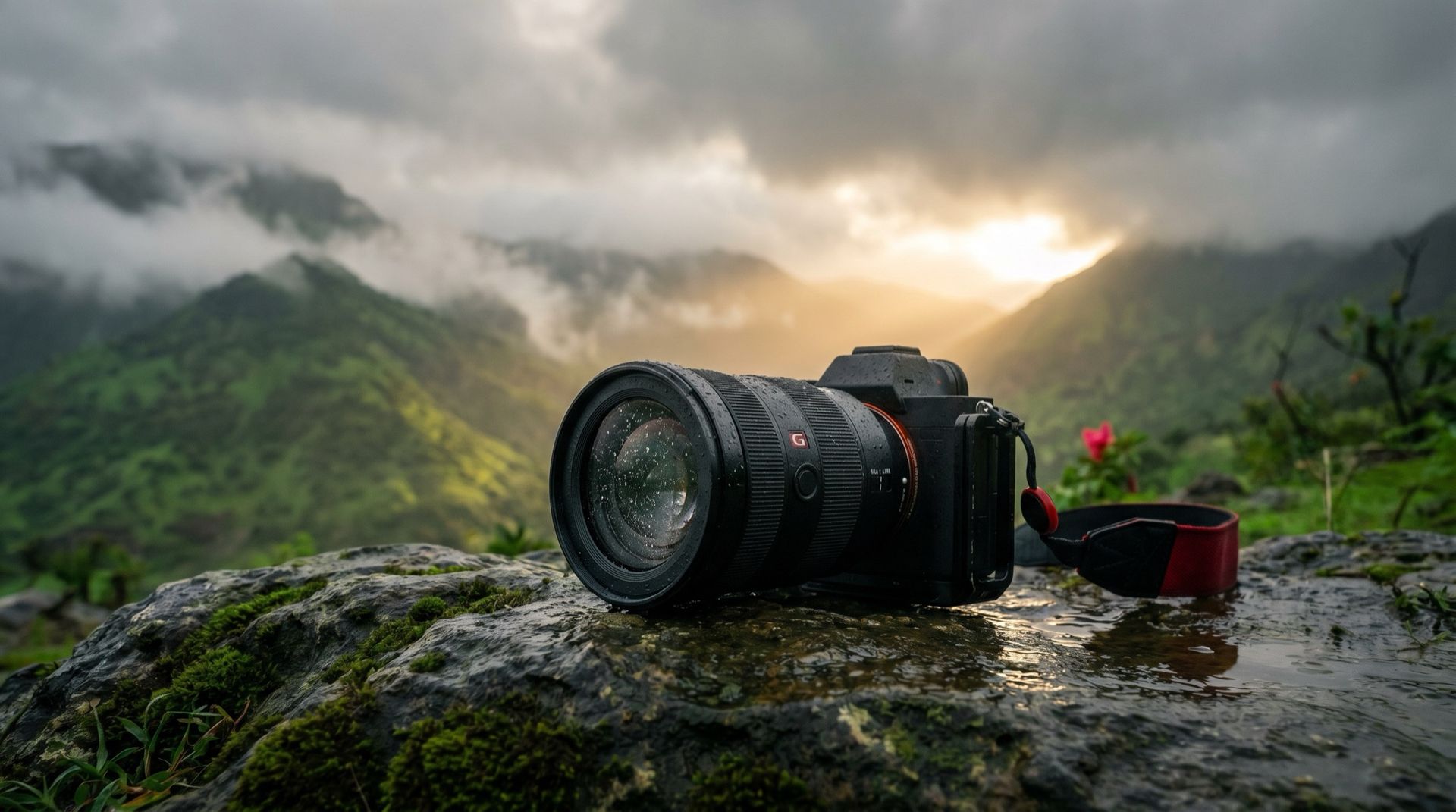
Six simple habits keep your gear dry, fungus-free and shooting all Khareef.
Khareef is made of exactly what cameras hate: moisture. From about 21 June to 21 September, Salalah lives in fog, drizzle and near-100% humidity — the same conditions that fog your lens, hide dust on your sensor and, over time, grow fungus on your glass. The good news: protecting your gear is easy once you know the routine. This is our practical Khareef care guide. Planning what to shoot with? See the Khareef gear page.
Six habits that save your gear
Short, practical, and specific to Dhofar's monsoon. Work through them once and they become second nature.
Condensation — the #1 Khareef riskMost common
Bring a cold, air-conditioned camera straight into warm, humid Khareef air and moisture instantly forms on the cold glass and metal — your lens fogs, and condensation can even form inside the lens and on the sensor. Shooting through it is impossible, and repeated wetting is what invites fungus later.
The fix: before you leave the car or hotel, seal the camera in its bag or a zip-lock bag while it's still cold, then let it warm up to the outside temperature before you open it — usually 15–30 minutes. Let the sealed bag, not the camera, collect the condensation. Never rush it, and never swap lenses in the fog.
Lens fungus & mould
Fungus is the long-term enemy. Warm, damp, still air in a dark closed bag is exactly what mould spores love — they grow as fine web-like threads on the glass and, left long enough, can permanently etch the coating and the lens element.
The fix: store gear dry and with some airflow, not sealed wet in a bag. Keep humidity down with silica gel or a dry box, and actually use your gear — lenses that sit unused in the damp for months are the ones that grow fungus.
Dry boxes & silica gel
The cheapest insurance you can buy. A sealed dry box with silica gel keeps stored gear at a safe humidity (around 40–50%), and an electronic dry cabinet holds that level automatically. Colour-indicating silica turns pink when it's full of moisture — dry it out (gently in an oven or by the recommended method) and it's reusable.
⚠️ We don't stock dry boxes, silica gel or dry cabinets yet — but we'll source them for you. Tell us your kit size and we'll find the right box. Ask on WhatsApp →
Rain covers & staying in the drizzle
Khareef drizzle is constant, so you'll want to keep shooting in it. A simple rain sleeve slips over the camera and lens and lets you work in light rain. For the wettest days, a natively waterproof action camera needs no cover at all — see the action cams on our Khareef page.
⚠️ Rain sleeves aren't in our catalogue yet — we'll source one to fit your camera and lens.
Sensor & lens care in the mist
Don't change lenses in the rain or fog. Every lens swap opens the camera to airborne moisture and dust that settle on the sensor. If you must, turn the camera body face-down, do it quickly, and shelter it. Got dust or a spot afterwards? Use a blower first — never wipe grit, or you'll scratch the coating. A gentle cleaning kit handles smudges on glass; a truly wet or foggy sensor is best left to a professional clean.
PhotoTech Full-Frame Lens & Sensor Cleaning Kit (8.900 OMR) or the PhotoTech Camera Cleaning Travel Kit (7.900 OMR) cover the basics — or bring it to our Muscat showroom.
The after-shoot routine
How you pack down matters more than most people think. When you get back:
1) Let the gear reach room temperature before you seal it away. 2) Wipe the body and lens with a dry microfibre cloth. 3) Don't lock wet gear in a closed bag — air it out first. 4) Take the battery and card out, then store the camera in your dry box / with silica at around 40–50% humidity. Check it again the next day for any moisture you missed.
📋 Your quick Khareef checklist
- Acclimatise: seal the camera in its bag and let it warm up before opening.
- Never change lenses in rain or fog — shelter and face the body down.
- Blower before cloth — never wipe grit off glass or the sensor.
- Dry storage: silica gel or a dry box at ~40–50% humidity.
- Air it out after a wet shoot — don't seal damp gear in a closed bag.
- Use your gear regularly; unused lenses in the damp grow fungus.
- Rain days: a rain sleeve, or a waterproof action cam that needs none.
Protect it — and gear up for the season
The two protection basics we'll source for you, plus the season hub and the cleaning kits we keep in stock.
Khareef camera-care FAQ
Why does my lens fog up in Salalah during Khareef?
It's condensation — moving cold, air-conditioned gear into warm, humid air makes moisture form on the cold glass. Let the camera warm up to the outside temperature (sealed in its bag) before you open and use it.
Can humidity really damage my camera?
Yes — repeated moisture invites fungus on lens glass, which can permanently etch the coating, and it can corrode contacts over time. Dry storage and a little routine prevent nearly all of it.
How do I prevent fungus on my camera lens?
Store gear dry with some airflow (not sealed wet in a bag), keep humidity around 40–50% with silica gel or a dry box, and use your lenses regularly — unused gear in the damp is what grows fungus.
Do you sell dry boxes and silica gel in Oman?
Not yet — but we'll source a dry box, silica gel or a rain cover for your exact kit. Tell us on the Source It page or message us on WhatsApp.
Can I use my camera in the rain during Khareef?
In light drizzle, a rain sleeve over a camera and lens works well; heavier rain calls for a weather-sealed body and lens. For the wettest conditions, a natively waterproof action camera needs no cover at all.
Not sure what your kit needs?
Tell us what you shoot and where — we'll recommend the right protection and, if you like, the gear for the season. We reply on WhatsApp during working hours.
All prices VAT-inclusive, in Omani Rial. Genuine gear, in stock at our Muscat showroom.
Gear news, the moment it lands in Oman
Drop your email for new arrivals, seasonal guides and Khareef tips. No spam, unsubscribe anytime.
General camera-care guidance for humid conditions. Prices shown are live Skyorbits prices at time of writing.